13 October 2026
Straddle carrier vs reach stacker: telling them apart in satellite imagery
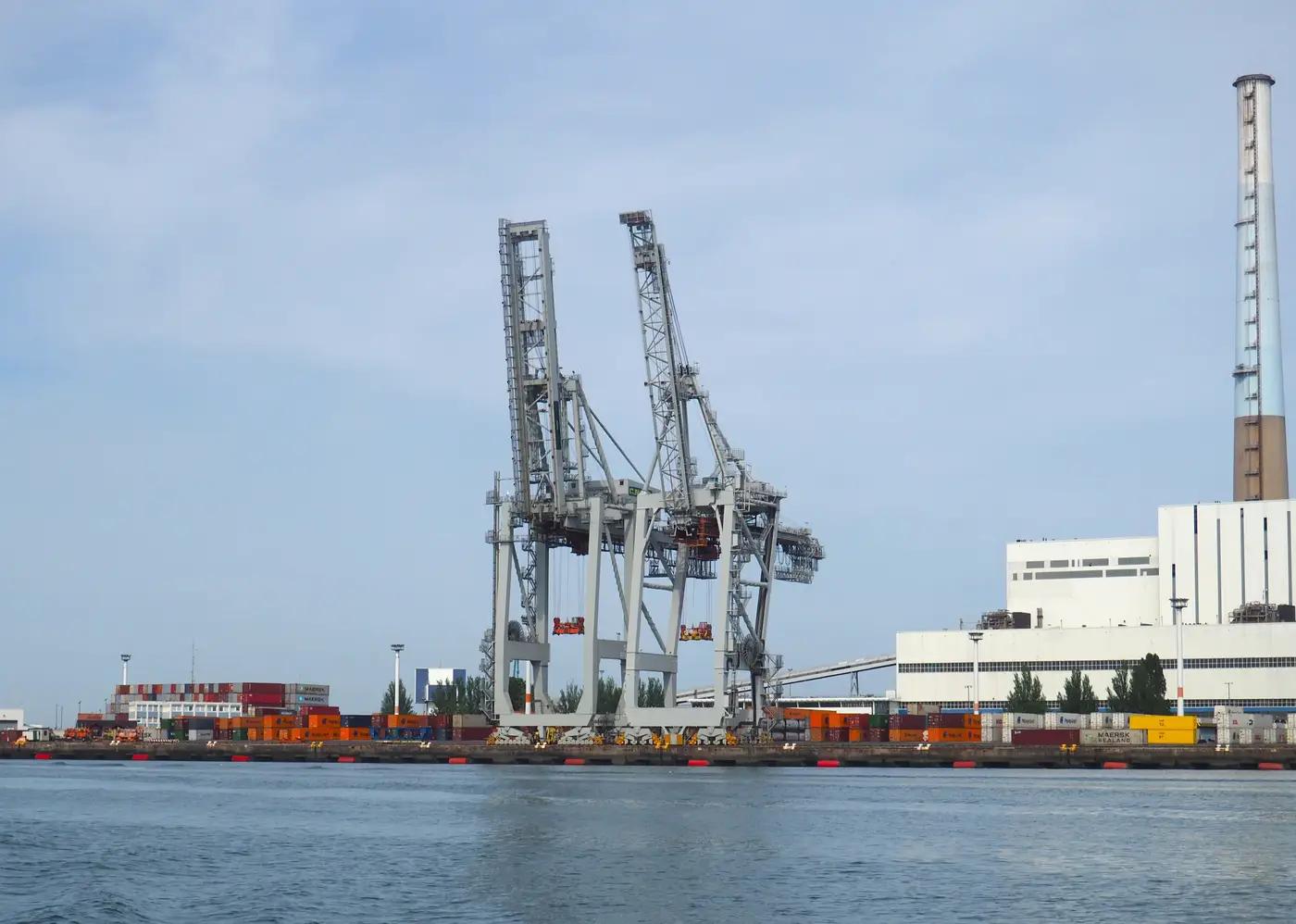
Pull up a high-res pass over almost any container terminal and the yard reads as a grid of boxes with a scatter of machines moving between rows. At 0.5 to 1 meter resolution, two of those machines look similar enough from directly overhead that people new to reading port imagery mix them up constantly: the straddle carrier and the reach stacker. Getting the distinction right matters if you're trying to read a terminal's equipment mix from above, because the two machines tell you very different things about how that yard is run and what kind of capacity problem it might be heading toward.
The shape from directly overhead
A reach stacker is built like a forklift with a telescoping boom bolted onto a wheeled chassis. From above it shows up as a rectangular counterweighted body with a long arm reaching out to one side, often angled, with the container it's lifting offset from the vehicle's own footprint. The chassis itself is compact, usually under 20 meters long with the boom extended, and it sits low and close to the ground.
A straddle carrier is a different animal. It's a portal frame on four corner-mounted wheel sets that drives straight over a container and lifts it up inside its own legs. Overhead, a straddle carrier reads as a near-square or slightly rectangular frame with a visible void in the middle where the container sits, and the container, if it's carrying one, is centered under the machine rather than hanging off to one side. The frame height changes the shadow geometry too. At midday, a straddle carrier throws a tighter, boxier shadow than the long diagonal shadow a reach stacker's boom casts.
If you're working from a single quarterly pass rather than a live feed, shadow length and direction are often your best clue when the resolution doesn't quite resolve the boom versus the frame. A reach stacker's shadow shows an arm extending past the vehicle body. A straddle carrier's shadow stays inside roughly the frame's own footprint, because there's no boom sticking out.
Why the equipment mix tells you something
Terminals don't pick between these two machines at random. Reach stackers dominate at smaller or mixed-cargo yards, at terminals handling lower box volumes, or in overflow and rail-adjacent storage areas where flexibility matters more than throughput. Straddle carriers show up at higher-volume dedicated container terminals, where the yard is laid out in long parallel stacking lanes built specifically around that portal-frame movement pattern. A yard running reach stackers today but pouring new paving in long straight lanes is telling you something about where it's headed, well before anyone issues a tender for straddle carriers or gantry cranes to match.
That's the part worth tracking if your job is forecasting demand rather than cataloguing hardware. A terminal switching its paving pattern from scattered reach-stacker lanes to the long straight runs straddle carriers need is a terminal planning a fleet change, and that paving work shows up in overhead imagery well before the fleet order does. Terminal Expansion Watch tracks that kind of yard and quay work on a quarterly pass across the terminals on your account list, so a paving shift like that lands in your pipeline as a dated alert instead of something you notice only after a competitor's crane is already on the berth.
A quick field check
If you only remember one rule: look at where the box sits relative to the machine. Offset to the side of a compact chassis, it's a reach stacker. Centered under a four-legged frame, it's a straddle carrier. When the imagery is too coarse to resolve that clearly, read the lane layout instead. Long straight parallel runs favor straddle carriers; shorter, more irregular stacking blocks favor reach stackers or a mixed fleet.
None of this replaces a site visit or a spec sheet from the terminal operator, and a single pass can still leave you guessing on a partly obscured yard. But for reading equipment mix off satellite imagery before you've got boots on the ground, the shape of the lift point and the geometry of the yard paving will get you most of the way there.
Worth finding out which terminals on your list are repaving for a fleet they haven't ordered yet.